
The Castle Douglas Circle
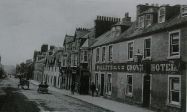
The Castle Douglas Circle
At Cowper's School, Sam formed friendships that would last a lifetime and shape his literary career. The bonds formed in Castle Douglas classrooms became professional collaborations that enriched his work.
Three Friends
William MacGeorge and John Copland both became artists. Andrew Penman pursued engineering. All three were Sam's classmates at Cowper's School, and all three would later appear, fictionalised, in his novels.
These were not merely childhood companions. They were friendships that deepened into genuine professional partnerships. MacGeorge provided the illustration of Ruth Milner that appeared as the frontispiece in Crockett's 1885 poetry collection Dulce Cor. MacGeorge and Penman both featured in the comic short story 'Mac's Enteric Fever' (in Bog Myrtle and Peat, 1895). Copland created illustrations for Malcolm Harper's 1907 biography Crockett and Grey Galloway, including the street scene of Cotton Street as it appeared in their boyhood.
When Crockett achieved literary success, he actively promoted MacGeorge's career as an artist. In October 1893, he wrote repeatedly to his publisher T. Fisher Unwin, urging him to commission MacGeorge for The Illustrated Stickit Minister: 'I am so anxious that he should do it... I would be glad to take a share of his renumeration if you wished me to do so.' The willingness to sacrifice part of his own payment demonstrates the depth of loyalty between the friends.
MacGeorge became the model for Jerry MacWhirter in The Raiders (1894) and the eponymous hero of Little Esson (1907). Penman appeared as Andrew Allison in The Raiders. These fictional portraits suggest the depth of connection—Crockett was not just using their names but exploring their characters and their shared experiences.
Castle Douglas as Literary Laboratory
The market town itself became essential to Crockett's imagination. Castle Douglas—'CD' to locals—offered everything a future novelist needed: a contained community with recognisable types, recurring patterns of behaviour, social hierarchies, and human drama played out in familiar settings.
Sam absorbed it all. The Douglas Arms Hotel, the Mart, the various shops and streets—each location was observed and recorded in memory with the precision that would later allow him to recreate them in fiction.
When readers of his novels encountered 'Cairn Edward', they were seeing Castle Douglas through Crockett's eyes. Local residents could identify every building, every street corner, every character type. The observational skills he developed during these years—watching people, listening to speech patterns, absorbing the rhythms of small-town life—became the foundation of his craft as a novelist.
Beyond the Town
Yet Sam's world extended beyond Castle Douglas itself. Although he lived in town from 1867 to 1876, the surrounding Galloway countryside remained central to his imagination. The combination was perfect for a future writer: intimate knowledge of a specific place, deep observation of human nature, lasting friendships with talented people, and the constant interplay between town and countryside that would characterise his best fiction.
By 1876, when he won the Galloway Bursary and prepared to leave for Edinburgh University, Sam had everything he needed. Castle Douglas had given him not just education but the material and methods that would define his literary career.
Read More:
'Mac's Enteric Fever' in Bog Myrtle and Peat, The Raiders and Little Esson in The Library
Image: MacGeorge's picture of Ruth Milner in Dulce Cor