
Browse Exhibits (7 total)

All About Raiderland
In 1904, Hodder & Stoughton published Raiderland — a literary-topographical book about Galloway by S.R. Crockett, with fifty drawings by the American artist Joseph Pennell. The book had taken five years to make.
This exhibition tells two stories: how the book was made, and what it turned out to be. The first story runs through the correspondence — letters, contracts, and business communications between Crockett, his literary agent A.P. Watt & Son, Pennell, W. Robertson Nicoll, and Hodder & Stoughton. The second story runs through the book itself: thirty-two chapters that are not quite what their author once planned, and rather more complex than they first appear.
This is our first major Autumn exhibition. It acts as spring-board to more in-depth information. Letters, contracts and texts are available in the archives and the exhibition offers links to some of these. The exhibition also show some of Pennell's illustrations and you can find the rest in the BOOK ILLUSTRATIONS collection.
For those who want to dig deeper into the content and context there are 'deep dive' articles in the Reading Room.
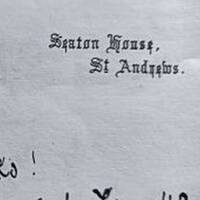
Between 1894 and 1898, S.R. Crockett spent part of his summers in St Andrews, and the correspondence written from there reveals a man juggling an extraordinary range of demands: publishers, aristocrats, American agents, medieval research, and an increasingly consuming interest in golf. This exhibition is evidenced largely through letters. Many of them were written from Seaton House. In the 1890s this was a boarding house, later it became The Scores Hotel and in 2025 it was rebranded as Seaton House, now a luxury hotel. Crockett's letters are addressed to book collectors and former prime ministers, to his publisher and his wife's friends. Together, they reconstruct five summers on the Old Course and the working life built around them.
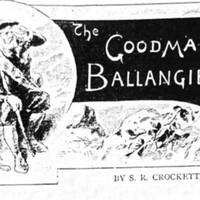
In December 1898, a story by S.R. Crockett appeared in The Lady's Realm, a popular illustrated London monthly. It ran to fourteen pages, carried five illustrations, and was set in the Galloway hills in the summer of 1531. A disguised king, a shepherd-farmer with a hackbut, a corrupt court favourite, and a sharp-tongued farmhouse wife — the ingredients of a historical romance with a great deal more going on beneath the surface.
Then the magazine moved on to the next issue. The story was never reprinted and never collected into any of Crockett's books. For over a century it sat in the holdings of university libraries in the original bound volumes of a periodical that hardly anyone still reads. Until now.
'The Goodman of Ballangiech' is available in this museum in full, for the first time in accessible form. This exhibition is its introduction.
The title of the exhibition works in several directions at once. 'No Small Stories' is partly a description of this particular story — substantial, historically grounded, technically ambitious, anything but throwaway. But it is also a statement about the writer who produced it. It speaks to the dismissal of S.R. Crockett over the past century. This exhibition, and the articles it draws on, offers an argument for reappraisal and rehabilitation into a recognised place in Scottish literary history.
The museum's approach is simple: make the evidence available and let the reader judge. The story is here. So are the arguments. Start wherever you like.
PLAGIARISM: WHAT I SAY THREE TIMES…
A Pop-Up Exhibition | S.R. Crockett Online Museum
Part One of: Digging Up the Kailyard — Sowing the Seeds
In November 1894, S.R. Crockett opened his reply to a plagiarism accusation in The Academy by quoting Lewis Carroll’s Bellman: “I have said it thrice: / What I tell you three times is true!” He was not being flippant. He was identifying a pattern — an accusation gathering authority through repetition rather than evidence. This exhibition follows the six-week exchange that resulted, and what it reveals about the critical machinery being assembled against Crockett in the months before “Kailyard” became a stigmatising word.
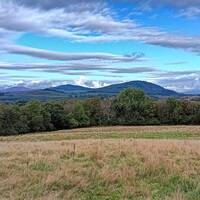
Galloway has been mapped and surveyed, measured and photographed. What the maps do not show is what it felt like to wedge a slate between beech branches and read there for an afternoon, legs swinging into empty air. What the surveys do not record is a sense of loss at the felling of a thorn tree, or the way a stand of pines looked at first light before the axes came.
Samuel Rutherford Crockett recorded all of this. Born in 1859 in the Galloway parish of Balmaghie, he grew up in a landscape that shaped him before he could name it — and he spent the rest of his life writing it back into being. Not the Galloway of estates and legal records, but the Galloway of children climbing oaks, of Covenanters sheltering in deep shadow, of young men and women meeting in canopies where the ordinary rules of class and propriety loosened among the branches.
This is a different kind of knowledge from anything a map can offer. Fiction tells us how landscape was lived in; what it felt like, what it meant, what was lost when it changed. Crockett's work sits at that intersection. He was not writing escapism. He was writing the kind of truth that other records leave out.
Think of this exhibition as the trunk of a tree. Each panel shows you a branch you can climb along. Branches (the fuller reading) are waiting in the resources we point you towards. Take your time. Wander in Galloways Woods with S.R.Crockett.
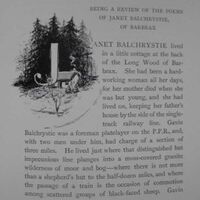
'The Heather Lintie' is a short story by Samuel Rutherford Crockett (S.R. Crockett, 1859–1914), published in 1893 in his first short fiction collection, The Stickit Minister and Some Common Men (T. Fisher Unwin). It runs to fewer than four thousand words. It may be short but it is no small story.
[You can download the story in The Stickit Minister from the library HERE]
This exhibition is part of Digging Up the Kailyard, a series of curatorial close readings that challenge one of the most damaging labels in Scottish literary history. 'Kailyard' — coined by the critic J.H. Millar in April 1895 to dismiss rural Scottish fiction as nostalgic and unserious — has shaped Crockett's critical reception for over a century. Our method here is simple: read the work carefully, and let the text answer the charge.
'The Heather Lintie' tells the story of Janet Balchrystie, a railway platelayer's daughter in Galloway who self-publishes a book of poetry, and of the metropolitan critic whose casual review destroys her. It has been read as a moral fable about the dangers of artistic ambition. Close reading reveals something quite different: sophisticated social satire that critiques literary journalism, exposes the economics of provincial publishing, and embeds a devastating portrait of cultural cruelty within a narrative that appears, on the surface, to confirm every sentimental expectation.
The irony is acute. The story was published in 1893, two years before Millar coined the Kailyard label. The metropolitan critic in the story — who cannot pronounce a Scottish surname and equates Galloway dialect with primitive speech — enacts precisely the prejudice that would later be directed at Crockett himself. 'The Heather Lintie' predicted its own misreading. When the Kailyard verdict came, it proved the story's point.
In this exhibition we move through the story in sequence: its industrial realism, its portrait of Janet, its insider account of provincial publishing, and the satirical heart of the piece.
We close with the contested final line — four words that have been used to dismiss the story entirely, and that repay rather more careful attention than they have received.
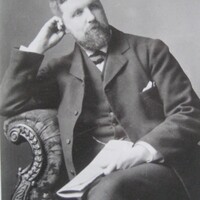
Becoming S.R. Crockett Inaugural Online Exhibition | S.R. Crockett Online Museum
Samuel Rutherford Crockett (1859–1914) was one of the most widely read Scottish writers of the Victorian era. At the height of his fame, his novels sold in their hundreds of thousands on both sides of the Atlantic. Yet his name is largely forgotten — and the story of how he became who he was has never been fully told.
Becoming S.R. Crockett is the inaugural exhibition of the S.R. Crockett Online Museum. It traces the first thirty-three years of his life: from his birth as an illegitimate child on a Galloway farm to the last day of 1892, when he wrote the letter that would launch his literary career.
Our digital exhibition boards draw on primary sources — birth certificates, letters, diaries, and university records, many published here for the first time — to follow the people who shaped him, the places that formed him, and the choices through which he fashioned his own identity.
This is the story of how a boy born with a blank on his birth certificate became S.R. Crockett, bestselling author.