The High Hole in Four: S.R. Crockett’s Golfing Ambition
When S.R. Crockett wanted to share his golfing triumph in October 1896, he wrote to Dan Mowat, a Glasgow bookseller with whom he shared interests in books and golf.
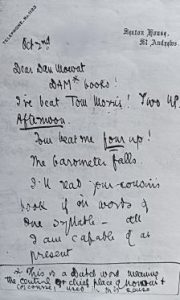
“I’ve beat Tom Morris! Two up. Afternoon. Tom beat me four up. The barometer falls.”
When S.R. Crockett wanted to share his golfing triumph in October 1896, he wrote to Dan Mowat, a Glasgow bookseller with whom he shared interests in books and golf. He’d just defeated Old Tom Morris—the legendary four-time Open Champion—in a morning round on the Old Course. The afternoon reversal didn’t dampen his spirits. The joke about the falling barometer shows Crockett’s characteristic humour.
The letter continued with news that The Grey Man had sold 45,000 copies before publication, then a quip about rival novelist Marie Corelli. But the real point came next: “But MY ambitions are to do the High Hole in 4 and make Willie Auchterlonie give me six strokes.”
The letter to Mowat shows Crockett unguarded—mixing triumph with self-mockery, literary success with golfing goals, all in the same breath.
Nearly two years later, writing to Major Pond—the American lecture tour impresario who’d been courting Crockett professionally—the high hole appeared again. The relationship between the two men was really business, though Crockett had invited Pond to St Andrews during his summer sojourn there. It’s a classic example of how personal business relationships could be. Crockett still again mentioned his golfing ambition: “My chief desire is still to do the high hole in four! Pardon the meanness of my ambitions.”
The phrase “meanness of my ambitions” repays attention. This was Scots self-deprecating humour—wry, aware of proportion. Perhaps I’m a bestselling author, the tone suggests, but I can’t master this hole. Even in professional correspondence, Crockett could laugh at his own priorities. It was also, perhaps a way of letting Pond down gently. Pond pursued Crockett for a couple of years, offering the riches of a literary tour. Crockett resisted and never took him up on the offer.
Learning the Game
It’s worth remembering, as Crockett self-mocks, that two years earlier, he hadn’t ever picked up a golf club. His first mention of the game came in July 1894 when he wrote to Dan Mowat: “I stay at St A with Lang pretty often and he abuses me for a heathen man and a publican for not playing.”
Andrew Lang—poet, folklorist, and one of Victorian Britain’s most influential literary critics—was calling Crockett names for not playing golf. Banter 1890s style. It seems Lang’s teasing worked. By 1895, Willie Auchterlonie—the 1893 Open Champion—had made Crockett a set of left-handed clubs. Crockett kept them in the shop, and only ever played golf at St Andrews.
Crockett’s St Andrews world was literary greats and golfing champions. He stayed with Lang, corresponded with him about medieval Scottish history, and learned the game that Lang insisted was essential to St Andrews life. On the links, he played with Auchterlonie and Old Tom Morris, learning from two of Britain’s finest golfers. Morris, in his seventies by the 1890s, was still formidable. Auchterlonie was at his peak, having won the Open Championship at age twenty-one.
By October 1896, Crockett was able to boast of beating Morris in a morning round. It was no small achievement. It reflects his hard work on the links. According to Laurie Auchterlonie, Willie’s son, when Crockett was at St Andrews he and Willie played “2 rounds of 18 holes every day, the first at 8 o’clock in the morning, the second in the afternoon.”
This wasn’t casual recreation. Crockett’s wife Ruth revealed the reality: “when we go to St Andrews, you know, he gets up at four in the morning and works just as hard as if we were at home, so, although it is a change of scene, it is no holiday as far as work is concerned.”
Four in the morning: writing. Eight o’clock: first round. Afternoon: second round. And he still had to fit in business and publishing communications. Between 1894 and 1898, this was Crockett’s summer routine for the weeks (sometimes months) he spent at St Andrews.
Class and the R&A
When Crockett was invited to join the Royal and Ancient Golf Club of St Andrews, a member questioned why he played with “professionals/caddies” instead of gentlemen. Crockett’s response was direct: “find me as fine a gentleman as Auchterlonie and I shall be glad to play with him.”
Willie Auchterlonie was the 1893 Open Champion and a skilled club-maker. But in the eyes of some R&A members, he was “professional”—someone who earned his living from golf. The distinction wasn’t about skill but about class.
Crockett’s reply defended his playing companion and asserted his own values. The democratic instinct was genuine—he’d defend those he respected regardless of their social position. After all, his own background was closer to Auchterlonie than to most members of the R & A.
St Andrews and Fiction
When staying with his family at St Andrews in the summer Crockett based himself at Seaton House in St Andrews each summer as a range of archive letters attest. He worked on some of his most successful works during this period including The Grey Man, Cleg Kelly andThe Black Douglas. He was granted reader privileges in the University Library. And he maintained correspondence with publishers and literary figures. Ruth was correct in pointing out that there was no real ‘holiday’ for Crockett at this point in his life.
The Grey Man (1896) is one of only two Crockett works featuring golf. Though set on the Ayrshire coast, its likely that St Andrews links may have inspired the novel’s golf scenes. The Manchester Guardian, covering Crockett’s competition winning round with Willie Auchterlonie in August 1897, noted: “Perhaps Mr Crockett will see his way to an imaginative treatment of the event.”
However, golf appeared again only in Sandy’s Loves (1913), a late semi-autobiographical work. In this work there is a feisty female golfer and her caddie and the golf is set on Leith Links and Portrush, Northern Ireland.
After 1898
Indeed the last reference to golf in Crockett’s archival correspondence comes in a letter to an unnamed correspondent in August 1898: “I have had a fine summers golf and am now again at work.”
After this: silence. There are no more letters from Seaton House. No more mentions of golf or St Andrews summers. However, both of Crockett’s daughters went to St Leonard’s School so we can assume that the family maintained something of a connection with the town throughout the years that followed.
St Andrews Day
On St Andrews Day, those of us with St Andrews connections remember our own ‘times’. And perhaps we remember what the town represents to golf’s history. But we might also remember S.R. Crockett—the writer who learned the game there, who played daily rounds with Open Champions, who wrote bestselling novels before morning and afternoon golf, and who pursued one particular goal on the 7th hole with characteristic determination.
The high hole remains at St Andrews. Crockett’s letters about it reveal someone who could laugh at his own priorities whilst caring deeply about them. “Pardon the meanness of my ambitions”—the phrase captures perfectly his self-deprecating humour and his genuine commitment to mastering what mattered to him.
For four St Andrews summers, golf was central to Crockett’s working life. And then, his life moved on. However, the years are preserved through photographs, newspaper articles, and some small fictional references as well as the letters – most notably that triumphant one: “I’ve beat Tom Morris!” It’s a phrase many of us would have wished to write.
Want to find out more? There’s a prototype exhibition titled Crockett, St Andrews and Golf available from now till January 2026. Just click the link above